Trump ‘simply doesn’t know what to do’ & wants out now | David Cay Johnston
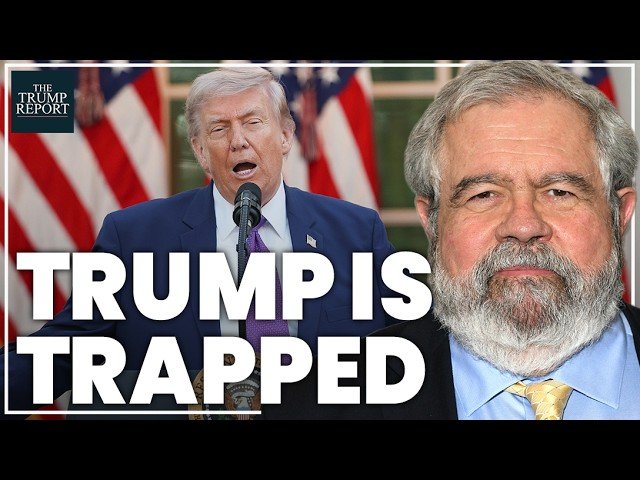
Let’s be honest — keeping up with the Trump administration right now feels like watching someone play chess while insisting they’re winning at checkers. The Iran situation shifts by the hour, a Kentucky congressional race has somehow become a $34 million proxy war, and somewhere in the middle of it all sits a president who, by his own account, has never made a mistake in his life.
We sat down with Pulitzer Prize-winning journalist and long-time Trump watcher David Cay Johnston to make sense of it all. Here’s what he had to say.
The Iran Strikes That Weren’t
Just when it looked like US strikes on Iran were imminent — with fresh attacks reportedly scheduled — Trump posted on Truth Social that the US would be standing down. His explanation? Gulf leaders asked him to. He name-checked the Amir of Qatar, the Crown Prince of Saudi Arabia, and the President of the UAE.
Thoughtful diplomacy, or a convenient exit ramp from a conflict that was already going badly? Johnston doesn’t mince words.
“Donald is flailing around,” he says. “He undertook this ridiculously stupid adventure which I’m absolutely certain American military planners said don’t do this.”
The numbers are sobering. Iran reportedly still has around 70% of the missiles and drones it started the conflict with, and has the manufacturing capacity to replenish quickly. Meanwhile, the US burned through expensive Patriot and Tomahawk missiles — costing $2 to $4 million each — to knock out $20,000 drones. A Senate hearing has since revealed it will take years, not months, to replace that stockpile.
“There is no example in history of an air campaign overthrowing a regime,” Johnston points out. The post-World War II bombing assessment, he notes, found that sustained bombing campaigns can actually harden civilian resolve rather than break it.
And the economic stakes? With the Strait of Hormuz remaining largely closed — normally around 150 ships pass through daily — the risk of global recession grows by the week. Fertiliser shortages, helium supplies for MRI machines, energy prices. The ripple effects are already being felt.
Why Trump Can’t Just Walk Away
Here’s the real bind, and it’s a psychological one as much as a strategic one.
Trump cannot admit defeat. Johnston has been documenting this for 38 years, and the pattern is consistent: the man has publicly acknowledged exactly one mistake in his life — saying he “never should have left in January of 2021.” That’s it.
“He refers to his perfect telephone calls, his perfect speeches,” Johnston says. “So to somehow back away from this, he would have to admit complete defeat. And I don’t think Donald’s ego is capable of doing that.”
What makes this even more striking is what Iran offered back in February — before the bombing began. By Johnston’s account, Iran put everything on the table: all the terms of the 2015 nuclear deal, plus an offer to allow American oil companies into Iran to develop oil fields and refineries. Trump could have walked out of the White House and declared it a bigger win than anything Obama achieved.
Instead, a few hours later, the bombs started falling.
Whether Trump didn’t receive the message, didn’t understand it, or simply chose to ignore it, Johnston can’t say for certain. What he can say is that right now, the Iranians “are in control here. Trump is not.”
The Xi Meeting Nobody’s Talking About Enough
Before we move on from the foreign policy picture, it’s worth pausing on last week’s meeting between Trump and Chinese President Xi Jinping — because Johnston’s read on it is pretty striking.
“Xi orchestrated the entire two-day meeting solely to humiliate Trump,” he says, “to show that he’s not an intellectual, doesn’t know who Thucydides is, and that he’s just not worthy of the position that he’s in.”
Trump reportedly fell asleep while Xi was speaking. He came home claiming deals for 200 Boeing jets and 750 engines. When the Chinese were asked about it, they said: “We believe in stable relations.” No deals were confirmed.
China, Johnston argues, has been preparing for this kind of standoff for nearly 15 years — building up oil reserves four times the size of America’s. They think in decades. Trump, in his telling, thinks about the next news cycle.
Kentucky: A $34 Million Primary That’s Really About Epstein
Halfway across the world from the Strait of Hormuz, something unusual is happening in Kentucky. The most expensive House of Representatives primary in US history is playing out between incumbent Thomas Massie and Trump-backed challenger Ed Galin, with over $34 million spent on the race.
Why does a congressional primary cost $34 million? Because this one is personal for Trump.
Massie, a libertarian-leaning conservative who has represented his district since 2012, has been one of the loudest voices demanding the release of the Jeffrey Epstein files. He even worked across the aisle with Democrat Ro Khanna to get legislation passed — unanimously through Congress, signed into law by Trump — requiring full disclosure of the Epstein documents.
The Trump administration then simply… refused to release them.
“Donald needs to get people off the Epstein files,” Johnston says plainly. “Getting rid of Massie should help him weaken any thoughts by Republicans in the House to demand an inquiry or even hold hearings.”
The irony is that Massie votes with the administration roughly 90% of the time. But loyalty with Trump, as Johnston puts it, “is a one-way street.” One act of defiance and you’re out.
Pete Hegseth — the Secretary of Defense — has been in Kentucky campaigning against Massie. Johnston is unambiguous: “The secretary of defense should be nowhere near any of this.”
What Happens If Massie Wins?
If Massie survives, it would be the clearest signal yet that Trump’s grip on Republican primaries isn’t quite as iron-clad as recent results have suggested. Senator Bill Cassidy of Louisiana, who had stood up to Trump, was recently reduced to just 25% of the vote. Principled independence, so far, has not been a winning strategy in Republican primaries.
But the Epstein issue has unusual cross-partisan resonance, and Trump’s approval on the war is historically weak — only about one in four Americans supports the Iran conflict.
Johnston’s broader point is worth sitting with: even if Trump wins this primary battle, the war is coming. Democrats are, in his assessment, near-certain to control the House after the November 2026 midterms. And when that happens, the Epstein files, the Iran war, and everything else won’t require a friendly Republican to keep quiet about.